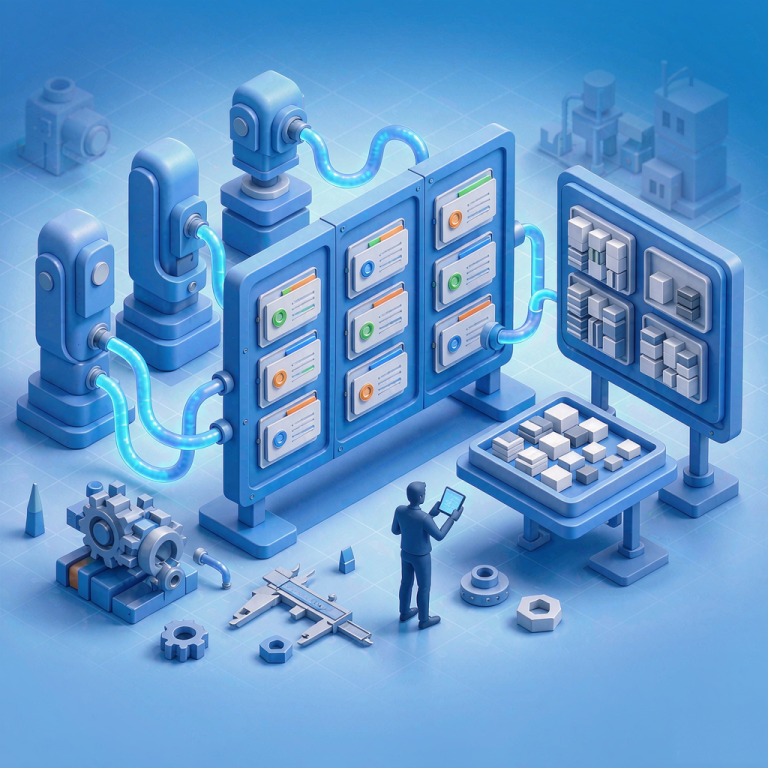
How to choose a workshop production progress tracking system? Comparison of three tiers: Excel, lightweight reporting, and MES.

Mold factory owners dread the phone calls on Friday afternoons. Customers are calling to inquire about the delivery status of the parts ordered the pr...


ERP Selection Guide for Small and Medium Manufacturing Enterprises: Real 2026 Quotation Ranges and the Five-Step Selection Method

When small and medium manufacturing owners consider adopting ERP, their first instinct is a "big and all-inclusive" system — stuffing finance, product...

  • Moges
  • 2026-11-03

Should a Twenty-Person Machining Factory Adopt MES or Not

This question has been asked too many times; the asker already holds an answer in mind and just wants someone to confirm it. I generally do not give a...

How to Set Up a Shop Floor Big Screen: Progress on the Wall, Announcements Scrolling

Many factories' big screens end up as "a PowerPoint hanging on the wall": lively for a day at launch, then three months without an update and nobody l...

What Production Management Software Should a Small Factory Use? Think Through These Three Questions Before You Choose

Lao He has been choosing software lately, and the process has worn him out. His plant has about thirty people and does precision part machining. The o...

Some Orders You Dare Not Take — Not Because You Can't Make Them, but Because You Fear You Can't Keep Them Under Control

There is a certain kind of order that many owners have seen before — they just dare not take it. A customer comes knocking: "This batch is urgent, can...

How to Straighten Out Chaotic Scheduling and Dispatching?

Lao Jiang's factory has twenty-eight people; the shop is not big, so voices must be. Every morning, assigning work relies on one shout — who runs whic...

When Customers Ask "Where Is My Goods", You No Longer Say "Let Me Ask the Shop"

There is one sentence owners taking orders say several times a week: "Hold on, let me ask the shop." After that sentence, the other end of the line us...

Affordable Management Tools for Small Factories: A Selection Guide Based on the "Three Essentials" Principle

In the mold processing industry in the Yangtze River Delta region, the vast majority of factories, with annual output values ranging from several mill...

Recommended Discrete Manufacturing Full-Lifecycle Management Software: A Comparison of Two Approaches and Selection Guide

In recent years, managers in the discrete manufacturing industry have been focused on finding a single management software solution that covers the en...

Mobile-PC Synced Mold Management Software: How Mold Factories Break the Information Silo Between Shop and Office

1. Why Mold Factories Need Mobile-PC Synced Management Software Many mold factory owners have lived this: traveling out of town, suddenly a call from ...

Lightweight Mold Management System Recommendations: How Small and Mid-Sized Mold Factories Solve 80% of Pain Points with 20% of the Budget

In digitalization discussions in the mold industry, one question keeps coming back: the owner wants a system, the IT manager recommends a full-process...

Contact Us

Now
Contact Us

We deliver professional solutions tailored to our customers' needs. Or share your valuable suggestions so we can improve and grow together!

Contact
Product & Service Inquiry

Free Online Consultation on Products & Solutions

Get a Quote

FAQ

Q: Is OpenStack suitable for small and medium-sized businesses?
A: Yes! We offer a lightweight deployment solution that starts with just 3 servers, at a cost far lower than VMware.

Q: What size of enterprise is Moges' production system suitable for?
A: Moges focuses on serving mold and precision machining enterprises with 10-300 people, covering segments such as stamping molds, injection molds, die-casting molds and precision part machining. Whether you are a dedicated mold manufacturer or a company with a machining workshop, we have a mature solution for you.

Q: What is the essential difference between an AI agent and an ordinary chatbot?
A: An ordinary chatbot can only answer one question at a time and tends to get stuck on complex questions. An AI agent can understand business rules, call on a knowledge base, and execute task flows. For example, it does not just answer price questions but also guides lead capture, classifies customers, and generates sales follow-up suggestions, truly becoming an AI employee of the company.

Latest News

Online Subscription